Sega Game Gear
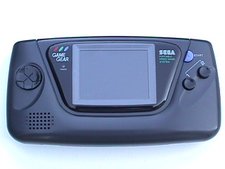
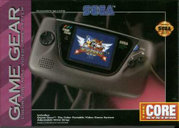
The Sega Game Gear is a handheld game console and was Sega's response to Nintendo's Game Boy. It is the second commercially available color handheld console, after the Atari Lynx. more...
Work began on the console in 1989 under the codename "Project Mercury", and the system was released in Japan on October 6, 1990. It was released in North America and Europe in 1991 and in Australia in 1992.
Design and technical features
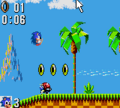
The Game Gear was basically a pocket Master System, but allowed a larger color palette, and therefore potentially better-looking graphics. Unlike the Game Boy, the system is held in a "landscape" position, with the controls at the sides, making it less cramped to hold. One of the more famous and unusual peripherals for the Game Gear was the "TV Tuner Adapter", a device that plugged into the system's cartridge slot, and allowed you to watch TV on the Game Gear's screen. Other addons included a magnifying glass to compensate the relatively small size of the GG's screen. Support for the TV Tuner was removed in later Game Gear units due to a lawsuit. (If the system's serial number begins with a letter -- not a numeral -- the TV Tuner will function with that particular unit.)
Sega had taken a similar approach when developing the Mega Drive/Genesis, basing it on Sega's 16-bit arcade hardware. This enabled direct conversion of popular games. Likewise, because of the similarities between the Master System and the Game Gear, it was possible for Master System games to be written directly onto ROMs in Game Gear cartridges. Similarly, an adapter called the "Master Gear" allowed Master System cartridges to be plugged in and played on the Game Gear. The reverse (playing a Game Gear game on a Master System console) was impossible due to the Game Gear's aforementioned larger color palette.
The Game Gear was not very popular in Japan, where it was released to a generally apathetic audience, with build quality issues plaguing it early in its service life(though fixed in later versions.Another problem was battery life. While better than earlier color backlit systems, it's 5 hours ( 6 in later versions) still wasn't as good as the Game Boy( due to that systems monochrome screen and 30% less powerful, though more battery friendly hardware)
Read more at Wikipedia.org