Sega CD
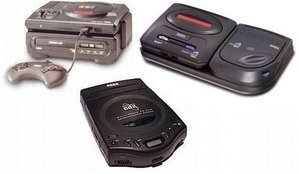
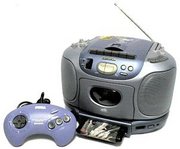
The Sega Mega-CD (Japanese: メガCD) is an add-on device for the Sega Mega Drive released in Europe, Australia, and Japan. The North American version is called the Sega CD. The device allows the user to both play CD audio discs and specially designed game CDs. more...
It can also play CD+G discs.
The development of the Sega CD was top secret; game programmers didn't know what they were designing for until the Mega-CD was finally revealed at Tokyo Toy Show in Japan. The Sega Mega-CD in Japan was designed to compete with the PC Engine, which had a separate CD-ROM drive.
The Sega Mega-CD was not meant to compete with the Super Famicom (Super Nintendo Entertainment System outside Japan).
At first, the Sega CD was a CD tray unit that sat under the console. The Sega CD 2 was a smaller, cheaper top loading drive that plugged next to the Sega Mega Drive.
In the United States, the Sega CD was considered a failure due to its high price, low sales and general confusion with the Sega 32X, another Genesis peripheral offered. Due to Sega of America's lack of support for the Sega CD and 32X, many consumers lost their trust in Sega and it can be said that Sega never recovered from this, as the Saturn sold poorly and the Dreamcast, although considered a good effort on Sega's behalf, was unable to compete effectively with the PS2.
Markets
Japan
The Sega Mega-CD was released first in Japan in 1st December 1991. Its retail price was about ¥49,800. Initially, it was a great success because of the inherent advantages of CDs (high storage capacity and the low cost of media). The fact that it had a nice RPG catalog also helped.
The system sold 100,000 units during the first year of release in Japan. However, cost issues prevented more units from being sold.
North America
Sega of Japan did not speak to Sega of America about their Mega-CD plans for that market until a few months later.
The Sega CD had been announced at the Chicago CES on November 1992. Early reports had suggested that hardware in the system would allow it to display more on screen colors (from a larger palette) than the Sega Genesis or the Super Nintendo, which was an important technical concern for consumers.
Read more at Wikipedia.org