The Nintendo GameCube (Japanese: ゲームキューブ; originally code-named "Dolphin" during development; abbreviated as GCN) is Nintendo's fourth home video game console, belonging to the Sixth generation era; the same generation as Sega's Dreamcast, Sony's PlayStation 2, and Microsoft's Xbox. The GameCube itself is the most compact and inexpensive of the sixth generation era consoles. The GameCube was released on:
- September 14, 2001 (Japan)
- November 18, 2001 (North America)
- May 3, 2002 (Europe)
- May 17, 2002 (Australia)
The GameCube was first introduced in volume #145 of Nintendo Power magazine. Luigi's Mansion was the first cover game (volume #150).
Launch titles
The GameCube launched in North America with the following twelve games:
Overview
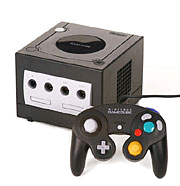
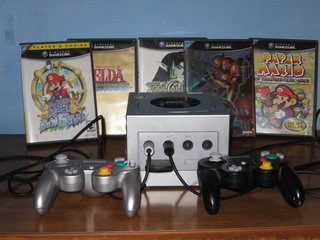
Unveiled during Spaceworld 2000, the Nintendo GameCube was widely anticipated by many who were shocked by Nintendo's decision to design the Nintendo 64 as a cartridge-based system. Physically shaped similar to a geometric cube, the outside casing of the Nintendo GameCube comes in a variety of colors, such as indigo, platinum, and black (also a limited edition Resident Evil 4 platinum and black game console). In Japan, the system is also available in orange, or in limited edition colors like Crystal White, Mint Green, Copper, and White with black pinstripes.
The Nintendo GameCube uses a unique storage medium, the GameCube Optical Disc, a proprietary format based on Matsushita's optical-disc technology; the discs are approximately 8 centimeters (3 1/8 inches) in diameter (considerably smaller than the 12cm CDs or DVDs used in competitors' consoles), and the discs have a capacity of approximately 1.5 gigabytes. Contrary to popular belief, gamecube discs are not physically read any differently from a standard DVD disc, but are encrypted and contain a 'barcode' unreadable by most dvdrom drives. This move was mainly intended to prevent piracy of GCN titles, but like most anti-piracy technology, it was eventually cracked. By exploiting a flaw in Phantasy Star Online Episode I & II, users were able to connect their GameCubes to their PC's and run homebrew programming on the console. . Later, a special debug mode in the GameCube drive was discovered which allowed the console to read and play from standard mini dvdrs.
Read more at Wikipedia.org