Sega Dreamcast
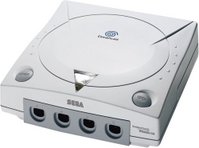
The Sega Dreamcast (Japanese: ドリームキャスト; code-named "Blackbelt", "Dural" and "Katana" during development) was Sega's last video game console. more...
An attempt to recapture the console market with a next-generation system, it was designed to supersede Sony's PlayStation and Nintendo's N64, and although generally considered to be "ahead of its time", it failed to gather enough momentum before the release of the PlayStation 2 a year later. After the Dreamcast was discontinued, Sega withdrew from the console hardware business.
History
When the time came to design the successor to the Sega Saturn, the new President of Sega, Shoichiro Irimajiri, took the unusual step of hiring an outsider. He hired Tatsuo Yamamoto from IBM Austin to head a skunkworks group to develop the next-generation console. However, it soon became apparent that the existing Japanese hardware group led by Hideki Sato did not want to relinquish control of hardware, and so there were two competing designs led by two different groups.
Design
The Japanese group led by Hideki Sato settled on an SH4 processor with a PowerVR graphics processor developed by VideoLogic which was later bought by NEC. This was originally codenamed "White Belt". The first Japanese prototype boards were silkscreened "Guppy" and the later ones "Katana".
The US skunkworks group (in a secret suite at the 303 Twin Dolphin Drive building) led by Tatsuo Yamamoto settled on an SH4 processor with a 3Dfx Voodoo 2 graphics processor, which was originally codenamed "Black Belt". The first US prototype boards were silkscreened "Shark" (in response to the Japanese "Guppy") and the later ones "Dural".
Contrary to popular misinformation, the Japanese hardware was never codenamed "Dural". This codename was only used by the US group, and in fact, the US hardware team called themselves the "Dural team".
Read more at Wikipedia.org