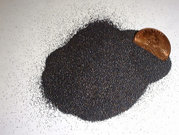
Titanium
Titanium is a chemical element in the periodic table that has the symbol Ti and atomic number 22. It is a light, strong, lustrous, corrosion-resistant (including resistance to sea water and chlorine) transition metal with a white-silvery-metallic colour. more...
Titanium is used in strong light-weight alloys (most notably with iron and aluminium) and its most common compound, titanium dioxide, is used in white pigments. Examples in which white pigment, consisting of titanium oxide, is used, is tippex and commonly used white paint to repaint walls. Substances containing titanium are called titaniferous.
This element occurs in numerous minerals with the main sources being rutile and ilmenite, which are widely distributed over the Earth. There are two allotropic forms and five naturally occurring isotopes of this element; Ti-46 through Ti-50 with Ti-48 being the most abundant (73.8%). One of titanium's most notable characteristics is that it is as strong as steel but is only 60% its weight. Titanium's properties are chemically and physically similar to zirconium.
Notable characteristics
Titanium is well known for its excellent corrosion resistance (almost as resistant as platinum), being able to withstand attack by acids, moist chlorine gas, and by common salt solutions. Pure titanium is not soluble in water but is soluble in concentrated acids. A metallic element, it is also well-known for its high strength-to-weight ratio. It is a light, strong metal with low density (60% as dense as steel) that, when pure, is quite ductile (especially in an oxygen-free environment), easy to work, lustrous, and metallic-white in colour. The relatively high melting point of this element makes it useful as a refractory metal. Titanium is as strong as steel, but 43% lighter; it is 60% heavier than aluminium, but twice as strong; however these numbers can vary a little because of the use of different alloys. These properties make titanium very resistant to the usual kinds of metal fatigue.
Read more at Wikipedia.org