Steel
Steel is a metal alloy whose major component is iron, with carbon being the primary alloying material. Carbon acts as a hardening agent, preventing iron atoms, which are naturally arranged in a crystal lattice, from sliding past one another (dislocation). more...
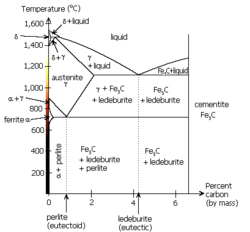
Varying the amount of carbon and its distribution in the alloy controls qualities such as the hardness, elasticity, ductility, and tensile strength of the resulting steel. Steel with increased carbon content can be made harder and stronger than iron, but is also more brittle. One classical definition is that steels are iron–carbon alloys with up to 2.1 percent carbon by weight; alloys with higher carbon content than this are known as cast iron.
Currently there are several classes of steels in which carbon is replaced with other alloying materials, and carbon, if present, is undesired. A more recent definition is that steels are iron-based alloys that can be plastically formed (pounded, rolled, etc.).
Iron and steel
Iron, like most metals, is not found in the Earth's crust in a native state. Iron can be found in the crust only in combination with oxygen or sulfur. Typically Fe2O3—the form of iron oxide found as the mineral hematite, and FeS2—Pyrite. Iron oxide is a soft sandstone-like material with limited uses on its own. Iron is extracted from ore by removing the oxygen by combining it with a preferred chemical partner such as carbon. This process, known as smelting, was first applied to metals with lower melting points. Copper melts at just over 1000 °C, while tin melts around 250 °C. Both temperatures could be reached with ancient methods that have been used for at least 6000 years (since the Bronze Age). Since the oxidation rate itself increases rapidly beyond 800 °C, it is important that smelting take place in a fairly oxygen-free environment. Unlike copper and tin, liquid iron dissolves carbon quite readily, so that smelting results in an alloy containing too much carbon to be called steel.
Read more at Wikipedia.org