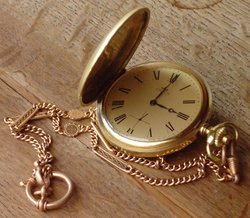
Pocket Watches
A pocket watch is a strapless personal timepiece that is carried in a pocket. The display is traditionally analog. more...
Pocket watches generally have a chain to be secured to a belt loop (the chain or ornaments on it being known as fobs), as well as a hinged cover to protect the face of the watch. Such covers are not always present. Also common are fasteners designed to be put through a buttonhole and worn in a jacket or waistcoat, this sort being frequently associated with and named after train conductors.
An early reference to the pocket watch is in a letter in November 1462 from the Italian clockmaker Bartholomew Manfredi to the Marchese di Manta, where he offers him a 'pocket clock' better than that belonging to the Duke of Modena. By the end of the 15th Century, spring driven clocks appear in Italy, and in Germany, Peter Henlein a master locksmith of Nuremberg is regularly manufacturing pocket watches by 1510. Thereafter pocket watch manufacture spread throughout the rest of Europe as the 16th Century progressed.
Overview
Pocket watches are commonly regarded as being one of two types: the lepine or the savonette. In a strict technical sense, the lepine is a watch whose winding stem is in line with the seconds-marking dial found on the face. The savonette has a winding stem perpendicular to the orientation of the seconds dial on the face of the watch.
Since the separate dial that marks the passage of seconds is traditionally placed closest to the six o'clock position, this means a traditional lepine's winding stem is set at its twelve o'clock position. The savonette's winding stem is placed most commonly at the three o'clock position. When read, a lepine is held with the stem straight up. A savonette is read by turning the watch 90° with the stem pointing to the right.
A lepine is traditionally an open-faced watch with a large, scratch resistant crystal covering the face. A savonette is commonly found in a 'hunter' or 'consular' case, with a protective lid hinged over the face. A consular case is further differentiated by the fact the back case is also hinged so that the watch movement can be easily separated from both halves of its protective cover.
Read more at Wikipedia.org