Silver, Solid
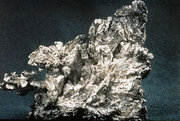
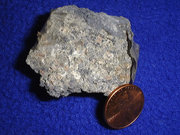
Silver is a chemical element with the symbol Ag (from the traditional abbreviation for the Latin argentum). A soft white lustrous transition metal, it has the highest electrical and thermal conductivity of any metal and occurs in minerals and in free form. more...
This metal is used in coins, jewelry, tableware, and photography.
Notable characteristics
Silver is a very ductile and malleable (slightly harder than gold) univalent coinage metal with a brilliant white metallic luster that can take a high degree of polish. It has the highest electrical conductivity of all metals, even higher than copper, but its greater cost and tarnishability has prevented it from being widely used in place of copper for electrical purposes.
Pure silver also has the highest thermal conductivity, whitest colour, the highest optical reflectivity (although it is a poor reflector of ultraviolet light), and the lowest contact resistance of any metal. Silver halides are photosensitive and are remarkable for the effect of light upon them. This metal is stable in pure air and water, but does tarnish when it is exposed to ozone, hydrogen sulfide, or air with sulfur in it. The most common oxidation state of silver is +1; a few +2 compounds are known as well.
Applications
The principal use of silver is as a precious metal. Its salts, especially silver nitrate and silver halides, are also widely used in photography (which is the largest single end use of silver). Some other uses for silver are as follows:
- Electrical and electronic products, which need silver's superior conductivity, even when tarnished. For example, printed circuits are made using silver paints, and computer keyboards use silver electrical contacts. Silver is also used in high voltage contacts because it is the only metal that will not arc across contacts, hence it is extremely safe.
- Mirrors which need silver's superior reflectivity for visible light are made with silver as the reflecting material in a process called silvering. Common mirrors are backed with aluminium.
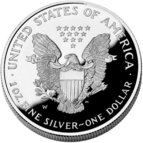
- Silver has been coined to produce money since 700 BC by the Lydians, in the form of electrum. Later, silver was refined and coined in its pure form. The words for "silver" and "money" are the same in at least 14 languages.
- The metal is chosen for its beauty in the manufacture of jewelry and silverware, which are traditionally made from the silver alloy known as Sterling silver, which is 92.5% silver.
- The malleability, non-toxicity and beauty of silver make it useful in dental alloys for fittings and fillings.
- Silver's catalytic properties make it ideal for use as a catalyst in oxidation reactions; for example, the production of formaldehyde from methanol and air by means of silver screens or crystallites containing a minimum 99.95 weight-percent silver.
- Used to make solder and brazing alloys, electrical contacts, and high capacity silver-zinc and silver-cadmium batteries.
- Silver sulfide, also known as Silver Whiskers, is formed when silver electrical contacts are used in an atmosphere rich in hydrogen sulfide.
- Silver fulminate is a powerful explosive.
- Silver chloride can be made transparent and is used as a cement for glass.
- Silver chloride is also a widely used electrode for pH testing and potentiometric measurement
- Silver iodide has been used in attempts to seed clouds to produce rain.
- In legend, silver is traditionally seen as harmful to supernatural creatures like werewolves and vampires. The use of silver fashioned into bullets for firearms is a popular application.
- Silver oxide is used as a positive electrode (cathode) in watch batteries.
- Colloidal silver is a possible antibacterial / antibiotic treatment that requires further clinical testing to support actual efficacy.
- Silver nitrate (liquid) and silver sulfadiazine cream (SSD Cream) were the "standard of care" for the antibacterial/antibiotic treatment of serious burns until the late 1990's. Now, Acticoat Burn Dressings (activated silver dressings) have largely replaced those earlier treatments.
Read more at Wikipedia.org