Gold, Solid
Gold is a chemical element in the periodic table that has the symbol Au (L. aurum) and atomic number 79. more...
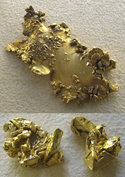
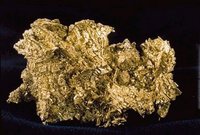
A soft, shiny, yellow, dense, malleable, ductile (trivalent and univalent) transition metal, gold does not react with most chemicals but is attacked by chlorine, fluorine and aqua regia. The metal occurs as nuggets or grains in rocks and in alluvial deposits and is one of the coinage metals.
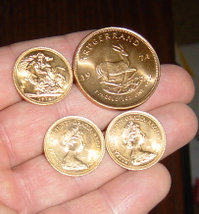
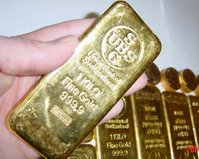
For millennia, gold has served as money and is also used in jewelry, dentistry, and in electronics. Gold forms the basis for a monetary standard used by the International Monetary Fund (IMF) and the Bank for International Settlements (BIS). Its ISO currency code is XAU.
Notable characteristics
Gold is a metallic element with a characteristic yellow color, but can also be black or ruby when finely divided, while colloidal solutions are intensely colored and often purple. These colors are the result of gold's plasmon frequency lying in the visible range, which causes red and yellow light to be reflected, and blue light to be absorbed. Only silver colloids exhibit the same interactions with light, albeit at a shorter frequency, making silver colloids yellow in color.
It is the most malleable and ductile metal known; a single gram can be beaten into a sheet of one square metre, or an ounce into 300 square feet. A soft metal, gold will readily form alloys with many other metals. This can be done to increase its strength, or create several exotic colors, sold for instance in the western United States to the tourist trade as "Black Hills" gold. Adding copper yields a redder metal, iron blue, Silver produces green, aluminium purple, platinum metals white, and natural bismuth together with silver alloys produce black. Native gold contains usually eight to ten per cent silver, but often much more — alloys with a silver content over 20% are called electrum. As the amount of silver increases, the color becomes whiter and the specific gravity lower.
Read more at Wikipedia.org