Opal
The mineraloid opal is amorphous SiO2ยทnH2O; hydrated silicon dioxide, the water content sometimes being as high as 20%. Opal ranges from colorless through white, milky blue, gray, red, yellow, green, brown and black. more...
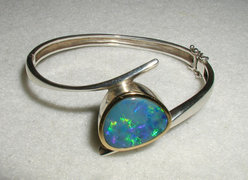
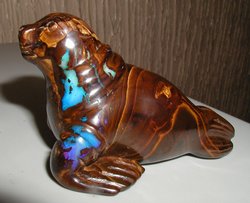
Often many of these colors can be seen at once, caused by interference and diffraction of light passing through minute, regularly arranged apertures within the microstructure of opal, known as Bragg's lattice. These apertures are filled with secondary silica and form thin lamellae inside the opal during solidification. The term opalescence is commonly and erroneously used to describe this unique and beautiful phenomenon, which is correctly termed play of color. Contrarily, opalescence is correctly applied to the milky, turbid appearance of common or potch opal. Potch does not show a play of color.
The veins of opal displaying the play of color are often quite thin, and this has given rise to unusual methods of preparing the stone as a gem. An opal doublet is a thin layer of colorful material, backed by a black mineral, such as ironstone, basalt or obsidian. The darker backing emphasizes the play of color, and results in a more attractive display than a lighter potch. Given the texture of opals, they can be quite difficult to polish to a reasonable lustre. The triplet cut backs the colored material with a dark backing, and then has a cap of clear quartz (rock crystal) on top, which takes a high polish, and acts as a protective layer for the comparatively delicate opal.
Common opal
Besides the gemstone varieties that show a play of color, there are other kinds of common opal such as the milk opal, milky bluish to greenish; resin opal, honey-yellow with a resinous lustre; wood opal, caused by the replacement of the organic material in wood with opal; menilite brown or grey; hyalite, a colorless glass-clear opal sometimes called Muller's Glass; geyserite, (siliceous sinter) deposited around hot springs or geysers; and diatomite or diatomaceous earth, the accumulations of diatom shells or tests.
Read more at Wikipedia.org