Abalone
Abalone is the American English variant of the Spanish name Abulón used for various species of shellfish (mollusks) from the Haliotidae family (genus Haliotis). The abalones belong to the large class of gastropods (Gastropoda). more...
There is only one genus in the family Haliotidae, and about four to seven subgenera. The taxonomy is somewhat confused. The number of species range from about 100 to about 130 species (due to the occurrence of hybrids), characterized by a richly coloured (on the inside--the outside is rough and mostly brown) shell yielding mother-of-pearl. This is also commonly called ear-shell, in Guernsey ormer (Fr. ormier, for oreille de mer), perlemoen in South Africa and paua in New Zealand. Abalone is also prevalent in Australian and South African coastal waters and is highly valued. The meat of an abalone is also considered an expensive delicacy in certain parts of South-East and East Asia, especially in Japan, although it has a high cholesterol content.
Distribution and characteristics
The Haliotid family has a worldwide distribution, along the coastal waters of every continent, except South America and the eastern coast of the USA. Most abalones are found off the Southern Hemisphere coasts of New Zealand, South Africa and Australia, and Western North America and Japan in the Northern Hemisphere.
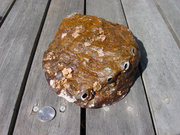
The family has unmistakable characteristics : the shell is rounded to oval, with 2 to 3 whorls, and the last one auriform ( = grown into a large ‘ear.’), giving rise to the common name ‘ear-shell”. The body whorl has a series of holes (four to ten depending on the species), near the anterior margin.
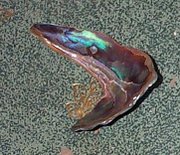
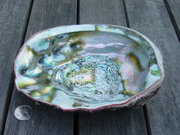
There is no operculum. The back is convex, ranging from highly arched to very flattened. These shells cling solidly with their muscular foot to rocky surfaces at sublittoral depths. The color is very variable from species to species. The inside of the shell consists of iridiscent, silvery white to greenred mother-of-pearl through to Haliotis Iris which can comprise of; pinks and reds with predominant deep blues, greens and purples.
Read more at Wikipedia.org