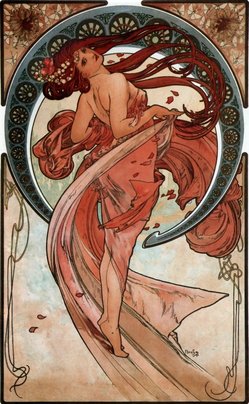
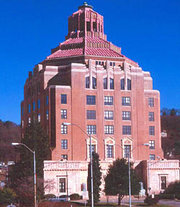
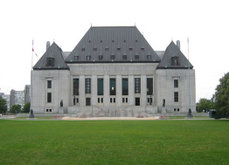
Art Nouveau/Art Deco 1895-1935
Art Deco (French: Exposition Internationale des Arts Décoratifs et Industriels Modernes) was an early twentieth century movement in the decorative arts, that also grew in influence to affect architecture, fashion and the visual arts. more...
Overview
Art Deco derived its name from the World's fair held in Paris in 1925, formally titled the Exposition Internationale des Arts Décoratifs et Industriels Modernes, which showcased French luxury goods and reassured the world that Paris remained the international center of style after World War I. Art Deco did not originate with the Exposition; it was a major style in Europe from the early 1920s, though it did not catch on in the U.S. until about 1928, when it quickly modulated into the Streamline Moderne during the 1930s, the decade with which Americanized Art Deco is most strongly associated today.
Paris remained the center of the high end of Art Deco design, epitomized in furniture by Jacques-Emile Ruhlmann, the best-known of Art Deco furniture designers and perhaps the last of the traditional Parisian ébénistes, and Jean-Jacques Rateau, the firm of Süe et Mare, the screens of Eileen Gray, wrought iron of Edgar Brandt, metalwork and lacquer of Swiss-Jewish Jean Dunand, the glass of René Lalique and Maurice Marinot, clocks and jewelry by Cartier.
The term Art Deco was coined during the Exposition of 1925 but did not receive wider usage until it was re-evaluated in the 1960s. Its practitioners were not working as a coherent community. It is considered to be eclectic, being influenced by a variety of sources, to name a few:
- Early work from the Wiener Werkstätte; functional industrial design
- "Primitive" arts of Africa, Egypt, or Aztec Mexico
- Ancient Greek sculpture and pottery design of the less naturalistic "archaic period"
- Léon Bakst's sets and costumes for Diaghilev's Ballets Russes
- Fractionated, crystalline, facetted form of decorative Cubism and Futurism
- Fauve color palette
- Severe forms of Neoclassicism: Boullée, Schinkel
- Everything associated with Jazz, Jazz Age or "jazzy"
- Animal motifs and forms; tropical foliage; ziggurats; crystals; "sunbursts"; stylized fountain motifs
- Lithe athletic "modern" female forms; flappers' bobbed haircuts
- "Machine age" technology such as the radio and skyscraper.
Corresponding to these influences, the Art Deco is characterised by use of materials such as aluminium, stainless steel, lacquer, inlaid wood, sharkskin, and zebraskin. The bold use of zigzag and stepped forms, and sweeping curves (unlike the sinuous curves of the Art nouveau), chevron patterns, and the sunburst motif. Some of these motifs were ubiquitous- for example the sunburst motif was used in such varied contexts as a lady's shoe, a radiator grille, the auditorium of the Radio City Music Hall and the spire of the Chrysler Building. Art Deco was an opulent style and this opulence is attributed as a reaction to the forced austerity during the years of World War I. Art Deco was a popular style for interiors of cinema theatres and ocean liners such as the Ile de France and Normandie.
Read more at Wikipedia.org