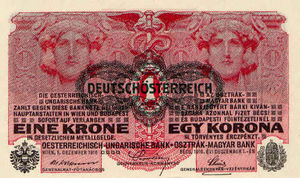
1/2 Crown
The Austro-Hungarian Empire adopted the gold standard in 1892 when the new currency of the crown (abbr. K), known as the krone in German, korona in Hungarian and as koruna in other imperial languages, was introduced. It consted of 100 hellers. more...
The value of the krone was set at 2 krone = 1 gulden (florin, or forint in Hungarian) of the previous silver-based currency. From 1900 onwards, krone notes were the only legal banknotes of the Empire.
The value of the currency depreciated sharply as a result of the First World War, which was financed mostly by the issue of War Bonds rather than through taxation. Consumer prices rose sixteen-fold during the war, as the government had no hesitation in running the Austro-Hungarian Bank's printing presses to pay its bills and triggering a higher inflation rate than in the other combatant countries.
After the end of the First World War it was initially hoped that the krone could continue as a common currency of the Empire's successor states, but in January 1919 the Kingdom of Serbs, Croats, and Slovenes (later Yugoslavia) became the first successor state to overstamp the Austro-Hungarian Bank's notes to limit their validity to its own territory. Czechoslovakia followed suit in February 1919, and on 12 March 1919 the new Republic of Austria stamped the notes circulating in its territory with "DEUTSCHÖSTERREICH".
The Austrian economy did not stabilise after the war, and a period of hyperinflation followed: money supply increased from 12 to 30 billion kronen in 1920, to about 147 billion kronen at the end of 1921. In August 1922, consumer prices were 14,000 times greater than before the start of the war eight years earlier. The highest value banknote issued was for 500,000 Kronen, in 1922. Faith in the currency had been lost, and money was spent as fast as it was received. In October 1922 Austria secured a loan of 650 million gold kronen from the League of Nations, with a League of Nations Commissioner supervising the country's finances. This had the effect of stabilizing the currency at a rate of 14,400 paper kronen to 1 gold krone. On 2 January 1923 the Austrian National Bank (Österreichische Nationalbank) started operations, and took over control of the currency from the Austro-Hungarian Bank which had gone into liquidation.
Read more at Wikipedia.org