Coins: Ancient
A coin is usually a piece of hard material, generally metal and usually in the shape of a disc, which is issued by a government to be used as a form of money. Along with banknotes, coins make up the cash forms of all modern money systems. more...
Coins are usually used for lower-valued units, and banknotes are usually used for the higher values; also, in most money systems, the highest value coin is worth less than the lowest-value note.
Collecting coins
See Coin collecting and Numismatics for more information on the collecting of coins, bank notes, token coins and Exonumia.
The value of a coin
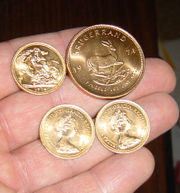
The market exchange value of a coin comes from its historic value, and/or the intrinsic value of the component metal (for example gold coins, silver coins or platinum coins).
However, in modern times, most coins are made of a base metal and their value comes strictly from their status as fiat money. This means that the value of the coin is decreed by government fiat rather than agreed by the people, which really makes it less a coin and more a token in the strictest sense.
To distinguish between these two types of coins, as well as from other forms of tokens which have been used as money, monetary scholars have defined three criteria that an object must meet to be a "true coin". These criteria are:
- It must be made of a valuable material, and trade for close to the market value of that material.
- It must be of a standardized weight and purity.
- It must be marked to identify the authority that guarantees the content.
By the above definition, the invention and first known usage of coins comes from the Kingdom of Lydia circa 643-630 B.C. Under three generations of Lydian kings, the money of Lydia gradually moved from being lumps of electrum (a naturally occurring alloy of silver and gold) to coins of a guaranteed weight and purity, marked with the seal of the King. True coins also developed very close to this time frame in both India and China.
Read more at Wikipedia.org