Coins: US 
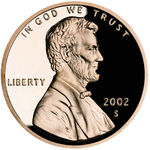
The United States one-cent coin, commonly called a penny, is a unit of currency equaling 1⁄100 of a United States dollar. Its obverse has featured the profile of President Abraham Lincoln since 1909, the centennial of his birth. more...
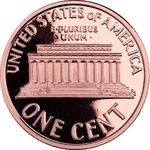
Since 1959 (the sesquicentennial of Lincoln's birth), the reverse has featured the Lincoln Memorial. The coin is .75 inches in diameter.
Despite the prevalence of the common term "penny", the U.S. Mint has never actually minted a coin for which this is the official name.
History of composition
- See also: History of the Lincoln cent
The cent's composition was changed in 1982 because the value of the copper in the coin started to rise above one cent. Some 1982 cents use the 97.5% zinc composition, while others used the 95% copper composition. In 1943, at the peak of World War II, cents of zinc-plated steel were made for a short time due to war demands for copper; a few (the U.S. Mint reports forty) copper cents from 1943 were produced. Following that year, salvaged ammunition shells made their way into the minting process, and it was not uncommon to see coins featuring streaks of brass or having a considerably darker finish than other issues.
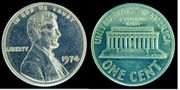
During the early 1970s, the price of copper rose to a point where the penny almost contained more than one cent's worth of copper. This led the Mint to test alternate metals, including aluminum and bronze-clad steel. Aluminum was chosen, and over 1.5 million of these were struck and ready for public release before ultimately being rejected. About a dozen aluminum cents are believed to still be in the hands of collectors, although they are now considered illegal, and are subject to seizure by the Secret Service. One aluminum cent was donated to the Smithsonian Institution.
Read more at Wikipedia.org