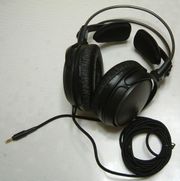
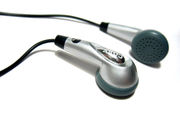
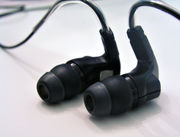
Headphones (also known as earphones, earbuds, stereophones, headsets, or the slang term cans) are a pair of transducers that receive an electrical signal from a media player or receiver and use speakers placed in close proximity to the ears (hence the name earphone) to convert the signal into audible sound waves.
Headphones date from the beginnings of the history of the telephone and the radio. The weak electrical signals of the early instruments were enough to operate only headphones audibly.
Although modern headphones are very widely sold and used for listening to stereo, especially since the invention of the Walkman, they are fundamentally unsuited to such use. This is why they usually produce the disconcerting effect of sound coming from the middle of the listener's head, with unnaturally isolated sounds occasionally appearing predominantly in one ear, giving the impression that the other has suddenly gone deaf. This is because stereo recordings represent the position of each sound by large amplitude differences between two channels intended for reproduction through a pair of loudspeakers. When the sounds from the two speakers mix at each each ear they create the phase difference which our brain uses to locate direction (at least below 2 kHz). Binaural recordings use a different microphone technique to encode direction directly as phase, with very little amplitude difference (except above 2 kHz) often using a dummy head, and can produce a surprisingly life-like spacial impression through headphones. Commercial recordings almost always use stereo recording though, because historically loudspeaker listening was more popular than headphone listening. It is possible to improve the spacial effect from stereo on headphones by using frequency-dependent cross-feed between the channels, or better still a Blumlein shuffler (custom EQ employed to augment the low-frequency content of the difference information in a stereo signal) though this is rarely done. While cross-feed can reduce the feeling of deafness in one ear, only the use of a dummy head when the actual recording is done, with artificial pinnae can convincingly take away the middle-of-the-head effect. Optimal sound can only be achieved when the dummy-head matches the listener's head, since pinnae vary greatly in size and shape.
Read more at Wikipedia.org