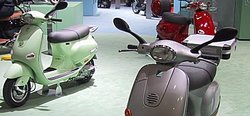
Vespa
The Vespa is a line of motor scooters that was first manufactured in Genoa, Italy in 1946 by Piaggio & Co, S.p.A. more...
Piaggio continues to manufacture the Vespa today, although the Vespa was a much more prevalent vehicle in the 1950s and 60s when it became the adopted vehicle of choice for the UK youth-culture known as Mods, and later Skinheads. The classic Vespas had unibody chassis pressed from sheets of steel, with bodywork covering the legs for protection from rain and mud. The engine was covered completely by a steel cowling to appeal to a broader market of people, often turned off by the dirty/greasy stereotype often applied to motorcycles. Piaggio revolutionized the two-wheel industry with the Vespa and provided a model on which nearly every other scooter made since has been based.
Most older Vespas have manual transmissions that are controlled by twisting the left handgrip while pulling the clutch lever and selecting between the 3 or 4 gears. They also have had two stroke motors, requiring a mixture of oil with the gasoline in order to lubricate the piston and cylinder. The mixture of oil in the fuel produced high amounts of smoke. Increasing environmental restrictions compelled Piaggio to pull out of the US market in 1985. Vespas would have completely disappeared from the American scene if it weren't for the enthusiasts who kept the vintage scooters on the road by rebuilding and restoring them.
Vespa returned to the US market in 2001 with a new, more modern style, and offers several models that have automatic transmissions and using both four stroke and cleaner two stroke engines. First came the ET2 (50 cc) and ET4 (50-124cc). Next came the larger 200 cc Granturismo 200. In 2004 they reintroduced a modernized PX 150. In 2005 a LX model that comes in both 50 and 125 cc versions in the UK and 50 and 150 cc version in the US. Most Vespas feature either a rear pillion for a passenger, or a storage compartment, just behind the driver's seat.
Read more at Wikipedia.org