|
Wrenches
A wrench or spanner is a tool used to turn bolts, nuts or other hard-to-turn items. more...
Home
Parts & Repair
Air Conditioning and Heat
Air Intake & Fuel Delivery
Air Tools
Brakes
Car & Truck Manuals
Charging & Starting Systems
Computer, Chip, Cruise...
Cooling System
Decals, Emblems, & Detailing
Diagnostic Tools / Equipment
Emission System
Engines & Components
Exhaust
Exterior
Filters
Gaskets
Gauges
Glass
Hand Tools
Hammers, Pullers, &...
Mixed Tool Sets
Other Hand Tools
Precision & Measuring Tools
Screwdrivers & Pliers
Sockets & Ratchets
Wrenches
Ignition System
Interior
Lighting & Lamps
Motorcycle & ATV Manuals
Other Parts
Other Tools
Parts Cars
Power Tools
Safety & Security
Shop Equipment
Shop Supplies
Suspension & Steering
Toolboxes, Storage
Transmission & Drivetrain
Turbos, Nitrous,...
Wheels, Tires & Parts
In American English, wrench is the standard term, while spanner refers to a specialized wrench with a series of pins or tabs around the circumference. (These pins or tabs fit into the holes or notches cut into the object to be turned.) In British English, spanner is the standard term. Hinged tools, such as pliers or tongs, are not generally considered wrenches.
Common wrenches
- Open-end wrench, or Open-ended spanner: a one-piece wrench with a U-shaped opening that grips two opposite faces of the bolt or nut. This wrench is often double ended, with a different sized opening at each end. The ends are generally oriented at an angle of around 30 degrees to the longitudinal axis of the handle. This allows a greater range of movement in enclosed spaces by flipping the wrench over.
- Box-end wrench, or Box spanner, or Ring spanner: a one-piece wrench with an enclosed opening that grips the faces of the bolt or nut. The recess is generally a six-point or twelve-point opening for use with nuts or bolt heads with a hexagonal shape. The twelve-point fits onto the fastening at twice as many angles, an advantage where swing is limited. Eight-point wrenches are also made for square shaped nuts and bolt heads. Box-ends are also often double-ended.
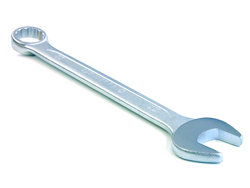
- Combination wrench, or Combination spanner: a double-ended tool with one end being like an open-end wrench or open-ended spanner, and the other end being like a box-end wrench or ring spanner. Both ends generally fit the same size bolt.
- Flare-nut wrench, or Tube wrench: used for gripping the nuts on the ends of tubes. The design is similar to a box–end wrench but with an opening to allow the wrench to fit over the tube.
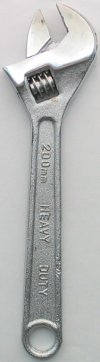
- Adjustable end wrench, or Adjustable spanner, or Shifting spanner: an open-ended wrench with adjustable (usually smooth) jaws, also sometimes called by the original patent holder's brand name as a Crescent® Wrench (Crescent Tool and Horseshoe Company).
-
-
- Monkey wrench: an old type of adjustable end wrench with a straight handle and smooth jaws, these are also known in the UK as 'gas grips'.
- Crescent® wrench: the brand name of an improved version of the adjustable end wrench (see the photo at right) developed by the Crescent Tool and Horseshoe Company. Often used as a generic term.
- Pipe wrench: an adjustable end wrench with self-tightening properties and hard serrated jaws that securely grip soft iron pipe and pipe fittings. Sometimes known by the original patent holder's brand name as a Stillson® Wrench.
- Socket wrench: a hollow cylinder that fits over one end of a nut or bolt head—may include a handle but usually used with various drive tools. It generally has either a six–point or twelve–point recess, may be shallow or deep, and may have a built-in universal joint. In addition, face driving sockets are available. These are more durable still, and have the ability to drive a range of hexagonal head sizes, with less risk of damaging the nut or bolt head than traditional "corner" drivers. The drive handles generally used are:
-
- a break–over (or hinged) handle.
- a ratchet handle (contains a mechanism which allows the socket to be turned without removing it from the nut or bolt).
- a speed handle (sometimes called a crank handle).
- a screwdriver handle (for use of the socket as a nutdriver).
- Sockets are often sold as a set containing a collection of sockets of various sizes and associated drive tools; usually including, as a minimum, extensions, a ratchet driver, and a universal joint. Sockets are also used with various power tools.
- Crowfoot socket wrench: a type of socket designed to fit some of the same drive handles as the regular socket but non-cylindrical in shape. The ends are the same as those found on the open-end, box-end, or the flare-nut wrenches. These sockets use for use where space restrictions preclude the use of a regular socket. Their principle use is with torque wrenches.
Read more at Wikipedia.org
• [List your site here Free!]
|
|