Studebaker
Studebaker Brothers Manufacturing Company was a United States wagon and automobile manufacturer that was incorporated in 1868. The company left the automobile business in 1966. more...
Early history
Henry Studebaker was a farmer, blacksmith, and wagon-maker who lived near Gettysburg, Pennsylvania in the early 19th century. By 1840 he had moved to Ohio and taught his five sons to make wagons. They all went into that business as they grew westward with the country.
Clement and Henry, Jr. became blacksmiths and foundrymen in South Bend, Indiana. They first made metal parts for freight wagons and later expanded into the manufacture of wagons. John made wheelbarrows in California and Peter made wagons in Saint Joseph, Missouri. The first major expansion in their business came from their being in place to meet the needs of the California Gold Rush in 1849.
When the gold rush settled down, John returned to Indiana and bought out Henry's share of the business. They brought in their youngest brother Jacob and incorporated in 1852. Expansion continued to support westward migration, but the next major increase came from supplying wagons for the Union Army in the American Civil War. After the war they reviewed what they had accomplished and set a direction for the company.
They reorganized into the Studebaker Brother's Manufacturing Company in 1868, built around the motto of "Always give more than you promise". By this time the railroad and steamship companies had become the big freight movers in the east. So they set their sights on supplying individuals and farmers the ability to move themselves and their goods. Peter's business became a branch operation.
During the height of westward migration and wagon train pioneering, half of the wagons were Studebakers. They made about a quarter of them, and manufactured the metal fittings to sell to other builders in Missouri for another quarter.
Studebaker Automobiles 1897-1966
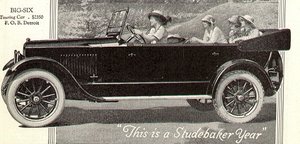
Studebaker experimented with motor vehicles as early as 1897, choosing electric over gasoline powered engines. The company entered into a distribution agreement with Everett-Metzger-Flanders (E-M-F) Company of Detroit; E-M-F would manufacture vehicles and the Studebakers would distribute them through their wagon dealers. Problems with E-M-F made the cars unreliable leading the public to say that E-M-F stood for "Every Morning Fix-it". J.M. Studebaker, unhappy with E-M-F's poor quality, gained control of the assets and plant facilities in 1910. To remedy the damage done by E-M-F, Studebaker paid mechanics to visit each unsatisfied owner and replace the defective parts in their vehicles at a cost of US$1 million to the company.
Studebaker also began putting its name on new automobiles produced at the former E-M-F facilities, both as an assurance that the vehicles were well-built, and as its commitment to making automobile production and sales a success. In 1911 the company reorganized as the Studebaker Corporation.
Read more at Wikipedia.org